Neptune's Pride Info Last Updated 2026/11/22 • Read Time 10min
___________________________________________________________________________
This page was created on 2026/11/21 to amalgamate research and data for the game Neptune's Pride.
I aim to eventually add some robust tools to this page wherein you simply enter the game code
and/or your API key and it will display the full galaxy map with complete gametick recording
(given enough players entered their API keys) as well as some other features like projected cash
flow of each player and data mining to keep track of every player's tech levels every tick and
who their potential tech donors are.
This works because while it is way cheaper to buy industry at levels 1 and 2, which is what you will do for most stars, having a bunch of 1 and 2 industry stars spread all over is logistically less efficient and thus much slower to harvest, especially during early game and even mid-game when you don't have warp gates and lots of looped carriers set up yet. If you have less stars with industry, but more industry per some individual star, it costs more credits but that star is more quickly fortified against attack and it means you have to make less stops to round up ships. So in the short term this is better, particularly if you're getting stomped on and need a quick boost, but in the long term you clearly get more from the spread-out approach since it's cheaper and you attain more total industry.


If we scale the chart logarithmically (see below) it becomes more clear where the key cutoffs are. Building a warp gate at a star with 10 resource costs 1,000 credits, a star with 20 resource costs 500 credits, a star with 30 resource costs 333 credits, and a star with 40 resource costs 250 credits. For almost every game of NP4 that you will play, there will never be a reason to spend more than 400 credits (25 resource) on a warp gate. This is because most stars worth traveling to fast for defense or offense will be higher resource anyways and should have carriers looped for bringing ships from the immediately surrounding smaller stars to them, making warp gates act as highways.

This can be exploited. If you are in a war with another player and are trading a lot of stars with them, using their warp gates for fast travel and deep-territory force projection gives you an opportunity to also destroy the gate once you hit the other side. This stops your opponent from being able to rapidly send ships back unless they also pay to recreate the warp gate. If you target particularly lower resource stars, this acts as a significant credit drain for your opponent.
At the start of the game, all players have a mutual relation level of zero (neutral) with all other players. This number is hidden until a player converts into an AI. This means that all AIs starting at the same time as the game have an initial relation level of zero. If, however, a player becomes an AI later on, then if you had ever attacked that player, you will start with a negative relation level with their new AI. If you have the most stars (i.e. located at the top of the leaderboard) when a player turns into an AI, the AI will default to a relations level of -1 with you.
If an AI has a positive relation with a player, then it will try to trade tech or pay off debts. If the AI has a negative relation with a player, then it will look for opportunities to attack. If the relation level is neutral, then the AI will be largely neutral.
To improve relations with an AI, send credits or technology. The maximum positive relation score you can have with an AI is +8. Sending any technology will increase the relations between you and the AI by 1. If you send credits you need to send the amount specified by the prompt on the AI's profile. Note, relations level can only ever increase by 1 for any amount of credits you send, so sending more than the amount specified in a single transfer will just waste the additional credits. The specific amount shown in the prompt to increase the relations level is always 5 × the AI's total economy.
You can decrease relations with an AI two ways: by being on top of the leaderboard (automatically turns relations to -1) or by entering combat with it. If you launch a carrier at any of its stars, the AI will automatically decrease its relations with you by 1. Each of its carriers you destroy in combat decreases its relations with you by 1. Every one of its stars you capture decreases its relations with you by 1. AIs will attack a player if their relation level with the player isn't positive (0 or negative). When a potential victim launches ships from a nearby star, the AI will consider attacking the star that was just left. If the AI has enough ships to capture the star, it will launch an attack. These attacks can pull in ships from multiple attacking stars. The AI doesn't account for any ships that are within range to defend the star, nor do they account for ships that the star will produce during transit.
When two AIs are in trading range (by default, this is the entire map, although some scenarios, such as 32 player games, limit this to scanning range), they will often trade technologies between themselves. This will usually lead to a runaway technology advantage, especially if one of the AIs has taken over from a well-off player. As far as I am aware, AIs will only trade technologies if they can both send something to the other AI. This may be such that one AI will send cash and the other will send a technology, or maybe they will only trade tech for tech. Either way, this is quite powerful when there are a lot of AIs within trading range of each other.
The single most important thing to know about NP4's AIs is that you can exploit them for tech trades. Provided that both of the following conditions are satisfied, the AI will probably send a technology back to you: you have positive relations with the AI and the AI must have enough cash to send a technology back. If satisfied, the AI will probably send you technology. The chance that they don't is negligible, but exists. The technology they send you is random, and could be of a higher or lower tech level than the one you sent to them. If they have a low star count, the credit requirement to increase relations becomes incredibly low and allows you to send vew few credits to get very high tech levels. This will give you a huge advantage if you do it first, before the AI's credits run out for tech trades.
The AIs are only active at certain star counts. An AI with more than 50 stars will not act in any way whatsoever. Once the AI has less than 50 stars, it will start acting again. When an AI is down to its last star it will never attack no matter what the player does, and will simply sit on its star until the star is conquered. When they are active, the AI has defined moments when they perform new actions, including reacting to the player's movements against them. Every 4 ticks, the AI will create new orders (including creating new carriers and/or building on their stars). They do nothing in between these 4-tick intervals. This holds true even in turn-based games where the turn length is not a multiple of 4, giving AI the ability to react to an action outside of the normal turn order.
If you lose all your stars but still have carriers in transit, you are not defeated. It is possible to come back and win from a position of zero stars.
np2-wallboard: a ten-foot style display for tracking stats in Neptune's Pride.
NP Sim: a genetic algo for brute-forcing opening moves to find optimal early game play.























































🙽 MANUFACTURING
With the way the formula works, improving a star's industry nets you more ships per tick
at that star than improving Manufacturing tech level. While improving manu level nets you
slightly more across all stars (see pic below), there is a short-term differential advantage in cost
and logistics qua stacking a single star for less overall industry.This works because while it is way cheaper to buy industry at levels 1 and 2, which is what you will do for most stars, having a bunch of 1 and 2 industry stars spread all over is logistically less efficient and thus much slower to harvest, especially during early game and even mid-game when you don't have warp gates and lots of looped carriers set up yet. If you have less stars with industry, but more industry per some individual star, it costs more credits but that star is more quickly fortified against attack and it means you have to make less stops to round up ships. So in the short term this is better, particularly if you're getting stomped on and need a quick boost, but in the long term you clearly get more from the spread-out approach since it's cheaper and you attain more total industry.
🙽 WARP GATE COSTS
The cost of buying warp gates with the default 'cheap' pricing (most people never change this in the game
settings) creates a power series where a star with 1 resource costs 10,000 credits to build and a star with
50 resource costs 200 credits to build, shown below. With terraforming tech enabled, building becomes even
cheaper since star resource scales up.If we scale the chart logarithmically (see below) it becomes more clear where the key cutoffs are. Building a warp gate at a star with 10 resource costs 1,000 credits, a star with 20 resource costs 500 credits, a star with 30 resource costs 333 credits, and a star with 40 resource costs 250 credits. For almost every game of NP4 that you will play, there will never be a reason to spend more than 400 credits (25 resource) on a warp gate. This is because most stars worth traveling to fast for defense or offense will be higher resource anyways and should have carriers looped for bringing ships from the immediately surrounding smaller stars to them, making warp gates act as highways.
This can be exploited. If you are in a war with another player and are trading a lot of stars with them, using their warp gates for fast travel and deep-territory force projection gives you an opportunity to also destroy the gate once you hit the other side. This stops your opponent from being able to rapidly send ships back unless they also pay to recreate the warp gate. If you target particularly lower resource stars, this acts as a significant credit drain for your opponent.
🙽 RESEARCH META
I'm tired and will add these later.
🙽 NP4'S BOTS
Sources: copied from BelSon's comprehensive NP2 AI Guide, plus additional NP4 tests.
When an AI takes over from a human player, it resets their empire. The AI will cancel all carrier
orders, and in a game with formal alliances the AI will immediately cancel all formal alliances it's in.
If a carrier is still in-flight, it will finish its current order, but all other orders will be removed.
AIs do not disable looping, so if a player quits while they have looped carriers then this can trap ships
on carriers looping on a single star, 'collecting all', which can potentially cripple the empire.
Lastly, the AI will determine its relationship level with every other player and AI in the game based on
prior trade and combat history, explained below.At the start of the game, all players have a mutual relation level of zero (neutral) with all other players. This number is hidden until a player converts into an AI. This means that all AIs starting at the same time as the game have an initial relation level of zero. If, however, a player becomes an AI later on, then if you had ever attacked that player, you will start with a negative relation level with their new AI. If you have the most stars (i.e. located at the top of the leaderboard) when a player turns into an AI, the AI will default to a relations level of -1 with you.
If an AI has a positive relation with a player, then it will try to trade tech or pay off debts. If the AI has a negative relation with a player, then it will look for opportunities to attack. If the relation level is neutral, then the AI will be largely neutral.
To improve relations with an AI, send credits or technology. The maximum positive relation score you can have with an AI is +8. Sending any technology will increase the relations between you and the AI by 1. If you send credits you need to send the amount specified by the prompt on the AI's profile. Note, relations level can only ever increase by 1 for any amount of credits you send, so sending more than the amount specified in a single transfer will just waste the additional credits. The specific amount shown in the prompt to increase the relations level is always 5 × the AI's total economy.
You can decrease relations with an AI two ways: by being on top of the leaderboard (automatically turns relations to -1) or by entering combat with it. If you launch a carrier at any of its stars, the AI will automatically decrease its relations with you by 1. Each of its carriers you destroy in combat decreases its relations with you by 1. Every one of its stars you capture decreases its relations with you by 1. AIs will attack a player if their relation level with the player isn't positive (0 or negative). When a potential victim launches ships from a nearby star, the AI will consider attacking the star that was just left. If the AI has enough ships to capture the star, it will launch an attack. These attacks can pull in ships from multiple attacking stars. The AI doesn't account for any ships that are within range to defend the star, nor do they account for ships that the star will produce during transit.
When two AIs are in trading range (by default, this is the entire map, although some scenarios, such as 32 player games, limit this to scanning range), they will often trade technologies between themselves. This will usually lead to a runaway technology advantage, especially if one of the AIs has taken over from a well-off player. As far as I am aware, AIs will only trade technologies if they can both send something to the other AI. This may be such that one AI will send cash and the other will send a technology, or maybe they will only trade tech for tech. Either way, this is quite powerful when there are a lot of AIs within trading range of each other.
The single most important thing to know about NP4's AIs is that you can exploit them for tech trades. Provided that both of the following conditions are satisfied, the AI will probably send a technology back to you: you have positive relations with the AI and the AI must have enough cash to send a technology back. If satisfied, the AI will probably send you technology. The chance that they don't is negligible, but exists. The technology they send you is random, and could be of a higher or lower tech level than the one you sent to them. If they have a low star count, the credit requirement to increase relations becomes incredibly low and allows you to send vew few credits to get very high tech levels. This will give you a huge advantage if you do it first, before the AI's credits run out for tech trades.
The AIs are only active at certain star counts. An AI with more than 50 stars will not act in any way whatsoever. Once the AI has less than 50 stars, it will start acting again. When an AI is down to its last star it will never attack no matter what the player does, and will simply sit on its star until the star is conquered. When they are active, the AI has defined moments when they perform new actions, including reacting to the player's movements against them. Every 4 ticks, the AI will create new orders (including creating new carriers and/or building on their stars). They do nothing in between these 4-tick intervals. This holds true even in turn-based games where the turn length is not a multiple of 4, giving AI the ability to react to an action outside of the normal turn order.
🙽 MISC NOTES
For new players: you can click 'C' to open the in-game combat calculator. Use it.If you lose all your stars but still have carriers in transit, you are not defeated. It is possible to come back and win from a position of zero stars.
np2-wallboard: a ten-foot style display for tracking stats in Neptune's Pride.
NP Sim: a genetic algo for brute-forcing opening moves to find optimal early game play.
🙽 PORTRAITS
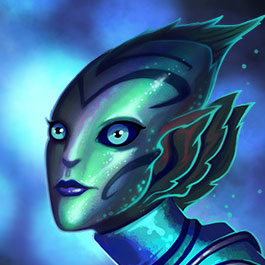
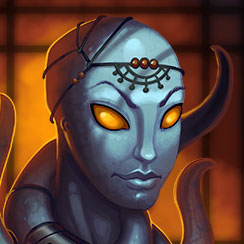
Below are all the currently available avatar portraits at their full site resolution, in numerical
order, including some works in progress. Portraits that have been removed, and empty placeholder
portraits, display as broken images for your browser.